Thursday, January 29, 2015

140 Characters or Less (x47)

What immediately strikes the reader about Jennifer Egan’s “Black Box” is her highly unusual style of writing.  Most notably, the story was released as a series of 47 tweets via the New Yorker’s Fiction Twitter feed.  This may seem an odd choice at first, but there is some significance to Egan’s use of Twitter here that works very well with her story.  In it, the unnamed central character is some sort of American intelligence agent tasked with gathering information on a violent man, her “Designated Mate,” who seemingly poses a threat to the U.S.  The way Egan presents her story through tweets goes along with the whole spy genre in a very interesting way.  The reader is given bits of information in packets of 140 characters or fewer that contain rather tense language, which makes the story resemble the type of communication one would expect from a spy.  Instead of simply writing “Black Box” in a more traditional style, this was a unique way for Egan to engage the reader while using the format of Twitter to her advantage in mirroring the spy theme of her story. 

Another noteworthy aspect of Egan’s writing style is her choice to use the 2nd person voice coupled with hypothetical speech.  The way in which this played out was very interesting.  While the text was littered with words like “if,” “may,” and “should,” Egan nonetheless is able to construct a concrete narrative around her main character.  Though they are somewhat limited, there are a background story and a sense of emotion from the unnamed female character.  This, combined with the fact that the story is written like an instruction manual, makes for a very strange read.  I had trouble understanding why Egan wrote the story as a series of hypotheticals, so here is the question I will leave you with:  Is there any meaning to be found in Egan’s decision to tell “Black Box” this way?  Why not just write it straightforwardly using past tense and first or third person?

Here is an interesting article that offers an opinion on the use of Twitter to disseminate works of literature:

Tuesday, January 27, 2015

Would You Walk Away?


At first glance, the city of Omelas appears to be a sort of Utopian society.  Everyone appears to be happy and enjoying life, and they are repeatedly described as joyous throughout the story.  It strikes me as a very Utopian-socialist sort of society, with no real class system, no leaders, and very few rules or regulations.  LeGuin notes, however, that they are not naïve and simple, but “mature, intelligent, passionate adults whose lives were not wretched.”(147)  Then, slowly, this façade seems to unravel, concluding with the little child locked in the basement.  This beaten, broken down child is forced to bear fear, despair, and every other negative emotion so that all of the rest of the people of Omelas can be happy. 

And yet, most of the society refuses to really acknowledge or react to this oppression.  Rather, they convince themselves that, for this child, it is for the best to simply abandon it because it could never fit into their society.  Most of these people have just accepted that this is the way things will be, that this one child must take the fall for them all.  They have fallen into the trap of their “perfect” society and are afraid of change, simply accepting that nothing can be done. 

The people of Omelas represent most of humanity today.  They are willing to accept some horrible oppression in their society because it is easy.  In our world, there are thousands of people suffering from oppression just like the child in the story, including women and Christians in the Middle East, homosexuals, and others. Like the people of Omelas, we often choose to ignore this because it is easier than trying to fix it.  The ones that walk away are the only ones who take the harder path, refusing to conform to a society based on oppression.  They will likely live a hard life, but did they go far enough?  Rather than simply walking away and abandoning the society, should they have freed the poor abandoned child, or was it better that he suffer to spare the rest of society?  They have clearly done something, and refused to simply ignore the problem, but did they do enough to help solve it?

Saturday, January 24, 2015

In Which Women are Likened to Rodents ...


              An opossum is considered by many to be nothing more than a dirty, scavenging rat. Ruth Parsons in Tiptree, Jr.'s The Women Men Don't See compares herself, and all women by extension, to this large rodent. Mrs. Parsons says that "What women do is survive. We live by ones and twos in the chinks of your world-machine." (271). This is a pretty clear statement on the condition of women and the roles they play in society, and while those roles may appear to have evolved over time, Mrs. Parsons feels that women are a "toothless world", able to drone on and on about "women's lib", but not really able to do anything to improve their condition. The Parsons are only two in number - Ruth and Althea - like the opossums Mrs. Parsons likens women to. There is no man in her life, and that seems to be preferable to her. She later implies that women have no brighter future to hope for - that they are merely present in a man's world, or "just part of the battlefield." Her view on the role of women leads her to express her desire to "go away".
             
             Convinced that the status quo will only change if men see fit to change it, she would rather just leave everything behind than try to make a difference. Mrs. Parsons has her wish granted in the end when she strikes a deal with a group of strange extraterrestrial beings. She and her daughter are, presumably, whisked away to live out the rest of their lives on some alien planet. We've seen this idea of leaving Earth in order to escape tragedy and find a fresh start on another planet come up before in some of Bradbury's stories. In one of them, Spender is so thoroughly disgusted with Earth that he'd rather live out the rest of his days on Mars. Is it worth trying to make significant changes in our lifetime or is the world such a hopeless place that it might be simpler to pack up and leave it all behind?

Thursday, January 22, 2015

Martian Morphing


In Ray Bradbury’s “The Martian” we meet an elderly couple that’s moved to Mars “to enjoy [their] old age in peace” and to “forget [their deceased son Tom] and everything on Earth” (Bradbury 182). However, this objective soon becomes difficult to accomplish, as the couple comes across a Martian who takes on the appearance of Tom and assumes his role in the family. As we saw in “The Third Expedition,” people on Mars find it incredibly difficult to separate themselves from their existence on Earth. And yet again, this doesn't end well.

LaFarge and his wife effectively recreate their life on Earth using the Martian. Although LaFarge initially questions the Martian, he eventually accepts it and even appreciates its presence. The Martian dines with the family and joins them on a trip to town, effectively filling the void in their lives left by the loss of their son. However, it later becomes evident that the Martian has the same effect on all those it comes across: one family views him as Lavinia, their late daughter, and he’s seen as a criminal by another. When he becomes surrounded by nearly every townsmen, he eventually melts into a pile of wax with several body parts mimicking those of the people he was modeling.


It’s the people’s inabilities to distance themselves from their pasts and from life on Earth that leads to the death of the Martian. Overwhelmed by the amount of people surrounding him and the necessity to appear as a significant dead person to each, the Martian literally suffers a meltdown. And although the parallel is not as obvious as it was in “The Moon Be Still as Bright,” there is a comparison to be drawn between this occurrence and some instances in history. Our inability to move away from our own way of life ultimately proves destructive for whoever we come across. We project our own values on people of different cultures despite an obvious incompatibility, and grow frustrated when it doesn't succeed. A policy of assimilation or annihilation had often been the course of action during the days of colonization; however, assimilation was too difficult for many as deeply ingrained cultural traditions and different customs often prevented a simple transition. This more than often led to miserable lives for the indigenous people or their complete destruction. The Martian’s utter collapse at the end of the short story could serve as a prominent example of the difficulty one could have conforming to the societal expectations of a different people. So I think it's important to ask ourselves: does our desire for familiarity override our capacity for openness to the unknown? Could we somehow manage to integrate ourselves to something new while preserving both our own identity and that of novel?

Tuesday, January 20, 2015

Love Trumps Logic in All Places

            “Where are you going?”  We have all asked and been asked this harmless question at one point or another.  Nevertheless, when Edward Black asks his brother, John Black, “where are you going,” (62) the common and familiar phrase transforms into an extraordinary, alien, and quite scary inquest.  Through Edward’s question in the final scene, Ray Bradbury explores the themes of deception, discipline, and death in “The Third Expedition” while trying to understand what makes us human.
            Upon arriving on Mars, the entire crew is deceived by the Martians.  One man says the town on Mars “looks like home” (42) and by nightfall each member of the crew, including the captain himself, abandon the order to remain by the ship because they all recognize a deceased loved one. 
            The loved ones are really just disguised Martians.  But because the feeling of love trumps logic for humans even on extraterrestrial planets, as witnessed earlier in Interstellar and this short story, the men abandon their plan and have no clue where they are actually going.  Only is it too late that Captain Black logically thinks and recognizes the Martian plan.  Because of the free will that each man possesses and the love each feels, the Martians were able to defend their territory and kill off the humans. 
I think that fear, failure, impulsive actions, free will, and love are necessary traits that make us human.  Although not always ideal, these traits have been elements of human existence throughout time.  As the world changes and technology advances, do you think that we should modify or change some of these human characteristics?  If we need to keep these human traits, how can we resolve the many issues that humanity faces?  If we need change, how much is needed before we lose our humanness?

Thursday, January 15, 2015

Your Classic Martian Marriage

Towards the end of the story “Ylla,” Mr. K decides to go hunting to pass the time until Dr. Nlle arrives. He puts on his silver mask, grabs his bee-shooting weapon and goes off. Not long after he leaves, Ylla feels “a warmth as of a great fire passing in the air…a gleam in the sky, of metal.” (15). This description gives the idea that a space ship has landed. Although it is never confirmed whether a space ship really landed on Mars, Ylla definitely hears two shots fired from Yll’s “evil insect weapon” moments after she sees the mysterious object falling from the sky. What’s more, readers never find out what exactly Yll fires at. Thus, readers are left wondering if Yll kills the very two ‘aliens’ who Ylla meets in her dreams.

I think this last scene is very significant because it highlights a theme present throughout the whole story: the theme of dreams and hopes. From the very beginning, Bradbury makes it clear that Ylla and Yll are unhappily married. In many ways, this couple resembles an American marriage, and just like any American trapped in an unhappy marriage, Ylla yearns for a happier life. I think she fulfills this desire for happiness through her dreams of the aliens. It’s funny to think of humans as extraterrestrial, but to the Martians, our race is strange indeed. Yet, it’s this very nature of the humans that Ylla is attracted to, for she not only finds the human Nathaniel to be oddly handsome, but she also enjoys kissing him in her dream. I read this as Ylla desiring to escape her mundane life and to experience something extraordinary, something (quite literally) out-of-this-world. By Yll shooting the two aliens (assuming those were his targets), he destroys Ylla’s fantasy of experiencing something unbelievable.

Perhaps Ray Bradbury uses this story as a commentary on the marriages in his day. Personally, I think "Ylla" shows how some couples, after years of marriage, lose the passion that once bound them together and dream for something else, something that may seem unattainable. Please comment if you agree/disagree and any other thoughts you may have.

Wednesday, January 14, 2015

You're Going to Miss Us When We're Gone... Right?

            In the short story “There Will Come Soft Rains,” Ray Bradbury urges readers to consider the ways in which life would continue if humans were to disappear. Through comparing the fictional universe presented in the story with the world depicted in Sara Teasdale’s poem, Bradbury concludes that if humans were to vanish, nature would begin to wither away while technology would continue on as if nothing had happened.  
            In the post-apocalyptic city of ruins know as Allendale, California, the only sources of “life” that are able to withstand the radioactive environment and carry on are a robotic house and the small mechanical animals that live within its walls (222). Completely oblivious to the fact that its owners are long gone, the house continues to cook, clean, fill bathtubs, play music, and read poetry aloud. The irony in this story presents itself in the scene where the house randomly decides to read a poem written by Sara Teasdale, which focuses on the ways in which nature would be able to flourish if humans were to destroy themselves in a war (225). The rather hopeful message of the poem stands in stark contrast with the reality of the short story. In the story, when the humans destroy themselves (most likely through a nuclear war), they leave nature to wither and die. This point is underscored in the passage where the cadaverous, “sore-infested” dog enters the robotic house in search of food (223). Having no humans to care for it and no small animals to hunt, the starving innocent beast of nature spins into a “frenzy and dies” (224).

            Even though a large portion of the house later goes up in flames, the small mechanical animals and automated calendar system both survive even though there is no longer anyone around to utilize either of them. In the end, it is the “ignorant” technology that humans once held in such high regards that survives, not mother nature. In reality, it is plausible that technology would outlive nature if humans were to disappear? Or would nature be able to move on without humanity and technology? 

Tuesday, January 13, 2015

An Imperfect Replication

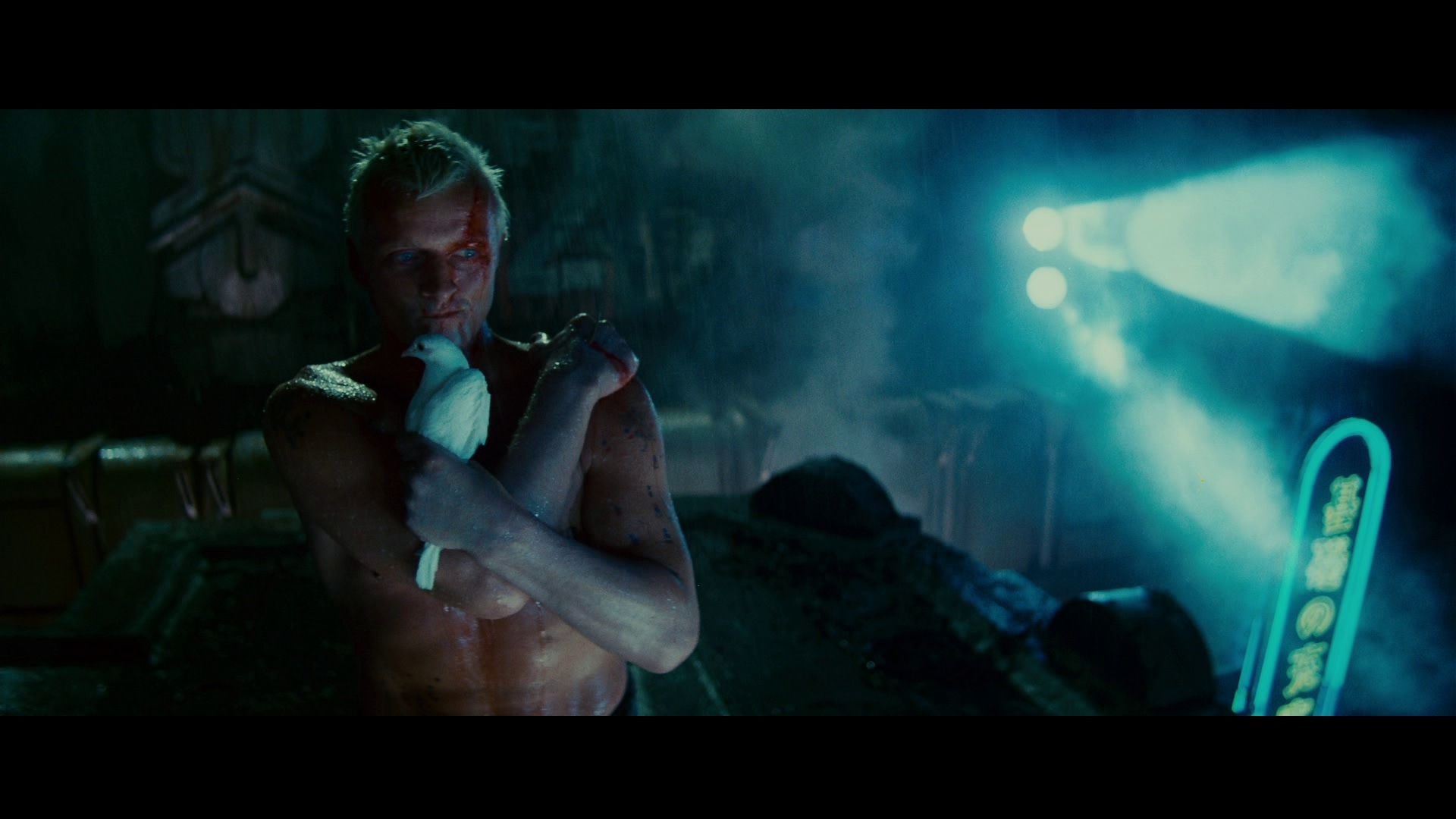
Harrison Ford’s performance in Ridley Scott’s Blade Runner was magnificent.  He captured the character of Rick Deckard perfectly, in my opinion.  Philip K. Dick, in Do Androids Dream of Electric Sheep, made it clear that Deckard is a worrisome, alone, and worn down bounty hunter who goes slightly insane and Scott portrays just that.  Another character that Scott masterfully created, this time diverging from the novel, was Roy Baty.  Baty’s crazed demeanor and his final Christ-like words that spared Deckard seemed so perfectly human.  He even held a dove, symbolizing the peace present in the air.
However, Roy Baty represents a major flaw that I had with the film.  When reading Dick’s novel, one could not help but notice the constant love for animals, the major question over empathy, Mercer, and how robotic the leader of the androids, Baty, was.  But Scott left all of this out of the film, focusing more on the setting and the different perspectives as he constantly and somewhat repulsively keened in on character’s eyes.  I loved the novel and anticipated seeing it played out right in front of me.  Rather, I got a film that used some of Dick’s characters and plot to tackle what I thought a related, but different question.  In Blade Runner, the major question revolved around Roy’s life, how close should humans attach themselves with replicants, and whether Deckard is a replicant himself.  But in Dick’s novel, the question centers on what makes us human and is our empathy authentic.  Related theme, yes.  The same, no.  Perhaps it is my fault for expecting the film to be like a play and follow the novel's exact script.  Nevertheless, I enjoyed the film and what it represents, but would not advise going to see it expecting a replicant, pun intended, of Dick’s Do Androids Dream of Electric Sheep.

Monday, January 12, 2015

Is this Post Real?


What is real? Can anything be proven objectively, without a doubt true? In the final chapters of Do Androids Dream of Electric Sheep, we find Rick Deckard's reality drastically changing. Mercerism is a hoax. The meaning of life and its true definition becomes blurry. What is happiness? These are all questions are few questions we are forced to contemplate at the conclusion of the novel. What really separates us from the androids, and what reality do we live in?

What we sense, remember, and love can all be boiled down to a series of biological hormones and electrical impulses. Maybe the mood organ is not as outlandish as it seem. Our brains, on a very basic level, works very similarly to a computer or robot. Computers are giant on-off switches. When electricity flows down the wire, the computer sees a 1. When the wire is dead, the computer sees a 0. Our brains work similarly. Neurons fire electrical pulses in complicated patterns throughout our entire nervous system. We are a series of electrical impulses. So, what makes us so unique? 

When Rick hears that Mererism is a hoax, he finds a new meaningful interpretation. Rick falls in love with an android. Even after finding out that his toad is electric, Rick seems satisfied. He does not object to dialing 670, long deserved peace, on the mood organ. Rick's entire life seems full artificial happiness. He lives in his own reality, which may not be objectively real at all.

As I contemplated the conclusion of Do Androids Dream of Electric Sheep, I could not help but think 'How important is it that I live a real life?' Isn't it more important to be happy in our own reality? How important can the distinction between human and robot be if we, ourselves, cannot know what true reality is? Do you think that the false reality created in Philip K. Dick's science fiction novel is inherently worse then an objectively true reality?

Thursday, January 8, 2015

Empathy: Our Barrier from Savagery
A crucial element to spotting the difference between a Nexus-6 android and a human is the emotion of empathy that only humans are able to .  However, what happens when you come across a human who doesn't have the ability to experience empathy for other living beings.  Does that automatically make that person a being that needs to be immediately “retired” because he lacks empathy?

Phil Resch, another bounty hunter that saves Rick from Garland’s trap and assists him in apprehending and retiring Luba Luft, is a character I believe Philip K. Dick  created in order to challenge the idea that empathy is an identifying factor in a human being.  Although in the novel it stresses that all humans and specials should express the feeling of empathy in a similar manner, it seems as though Phil lacks this emotion. Rick picks up on Phil’s lack of empathy because he sees first hand how cold-heartedly Phil “retires” the androids without a moments hesitation and seems to not pay any notice to how human the androids are.  In contrast, Rick is able to feel empathy for the struggle of the androids as he notices how they can contribute to society such as Luba’s singing.


This lack of empathy that Rick sees in Phil when he eliminates his targets makes Rick wish he turns out to be an android.  However, I see more going on here than I think is evident in the novel.  I don’t think it is only the fact that Rick sees the lack of empathy in Phil that he wishes for him to be an android. I believe it is the fear that if he turns out to be a human, then he will have to come to terms with the fact that humans do have the capability to lack empathy for other living beings.  That we do have the power to separate ourselves from our own humanity and take away someones life without any feeling of remorse afterward.

Wednesday, January 7, 2015

def human():

            Programming can be defined as creating rules for a system; in other words, given an input, what output should be produced. Such functions should be evaluated rigorously: if f(a) should produce b but instead produces c, there is an error which must be corrected.
            In our society, the adjectives ‘empathetic’ and robotic’ are often seen as antonyms. Some would argue that empathy, the driving force between altruism, is one of the most defining elements of humanity. Mercerism places a great emphasis upon empathy, seen through the empathy box. John Isidore explains to Rachael Rosen that “an empathy box is the most personal possession you have! It’s an extension of your body; it’s the way you touch other humans, it’s the way you stop being alone.” However, the empathy box shows that empathy box shows that empathy can and according to Mercerism, must, be induced.
            The Voigt-Kampff test works upon the principle that humans must respond to certain hypotheticals one way, and other stimuli the other way. This blurs the line between robotic and empathetic as, just as with a program, a certain output is expected given a certain input. In the case that that output is wrong (there is no emotional response), there is something wrong with that person (it is suspected they are an android) and that problem must be corrected (retired).
            When Rick gives the V-K test to Rachael Rosen, his results are initially inconclusive –only after an additional question can he distinguish her. His difficulty in identifying her underscores the haziness forming between human and android. Humans are expected to act a certain way, and with technology advancing, algorithms are developed to replicate that behavior.
            When Rick is arrested by the harness bull, he assumes that he has been captured by the androids. However, upon arriving at the police station, the situation becomes complicated: the officers are completely convinced that they are not robots. Rather, Garland suggests that Rick is an “escaped andy…posing as [an] out-of-state bounty hunter,” or that his memories have been simulated. As readers, we have no evidence to refute this claim. Indeed, we cannot even place full faith in the V-K test. At this point, the only character who we can decisively say was an android is Polokov due to the bone marrow test.
            Today, many computer scientists hypothesize that we are approaching what is known as a ‘technological singularity’. Technology, and in particular artificial intelligence, or AI, is nearing the point where it will exceed human intelligence. Already, we have software that writes itself and models which can predict some human behavior. As technology accelerates, how can we separate ourselves from artificial intelligence which seems to be assimilating within us (or perhaps exceeding us)? 

Tuesday, January 6, 2015

Drugs and the Mood Organ

(−)-trans9-tetrahydrocannabinol, better known as THC (the principle psychoactive constituent of marijuana)

In Chapter 1, when Rick Deckard and his wife Iran wake up in the morning, they discuss whether or not to use the 'mood organ,' a device which can instantly induce a specific state of mind (e.g. despair, wakefulness) in the user. This mood organ represents today's mind- and mood-altering drugs taken to their logical extreme. Superficially it seems like a liberating invention. After all, it can eliminate laziness, depression, anxiety, and unhappiness. But by making it easy to control emotion, it detaches emotions from their causes. Iran remarks, "I realized how unhealthy it as sensing the absence of life...and not reacting..." This "absence of affect" destroys the meaning of emotion. If emotions do not mean anything, how are they different from commodities; mere things to be sometimes avoided and sometimes sought after? In real life, when people take illegal drugs, they often do it for the euphoria of intoxication. This is nothing less than running away from the world. When feelings and reality are not in accord, is one not deluded?

The mood organ has another consequence. Along with moods, desires can also be induced, including the desire to use the mood organ. But this is problematic. As Iran states, "If I don't want to dial, I don't want to dial [#3] most of all because then I will want to dial, and wanting to dial is right now the most alien drive I can imagine..." Changing one's desires violates the integrity of the will. For when desires can be changed so easily, their significance and meaning is in danger. What should one change one's desires to? Are there 'better' desires that one ought to have? By acknowledging those better desires, doesn't one already desire them?

These questions are existentially threatening, if you're not using drugs or a mood organ. Therefore it isn't surprising that Deckard's wife Iran schedules despair for herself; even if the despair is artificially induced, it is in accord with reality and therefore (in a way) genuine.

Yes, this post is very opinionated, so feel free to deconstruct/refute/elaborate on what you see. Let's have a good discussion!