Tuesday, January 13, 2015
An Imperfect Replication
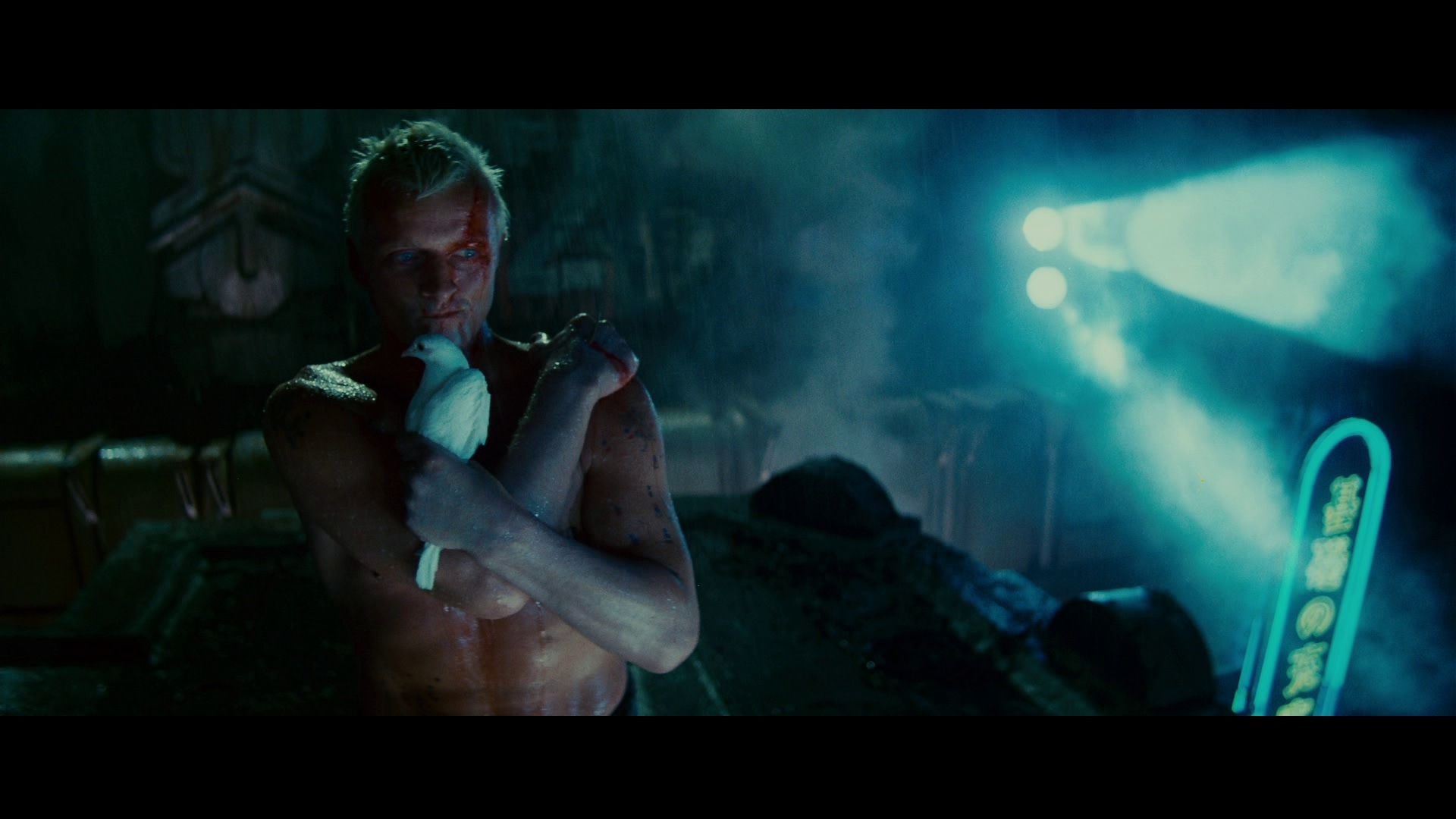
Harrison Ford’s performance in Ridley Scott’s Blade Runner was magnificent. He captured the character of Rick Deckard perfectly, in my opinion. Philip K. Dick, in Do Androids Dream of Electric Sheep, made it clear that Deckard is a worrisome, alone, and worn down bounty hunter who goes slightly insane and Scott portrays just that. Another character that Scott masterfully created, this time diverging from the novel, was Roy Baty. Baty’s crazed demeanor and his final Christ-like words that spared Deckard seemed so perfectly human. He even held a dove, symbolizing the peace present in the air.
 However, Roy Baty represents a major flaw that I had with the film. When reading Dick’s novel, one could not help but notice the constant love for animals, the major question over empathy, Mercer, and how robotic the leader of the androids, Baty, was. But Scott left all of this out of the film, focusing more on the setting and the different perspectives as he constantly and somewhat repulsively keened in on character’s eyes. I loved the novel and anticipated seeing it played out right in front of me. Rather, I got a film that used some of Dick’s characters and plot to tackle what I thought a related, but different question. In Blade Runner, the major question revolved around Roy’s life, how close should humans attach themselves with replicants, and whether Deckard is a replicant himself. But in Dick’s novel, the question centers on what makes us human and is our empathy authentic. Related theme, yes. The same, no. Perhaps it is my fault for expecting the film to be like a play and follow the novel's exact script. Nevertheless, I enjoyed the film and what it represents, but would not advise going to see it expecting a replicant, pun intended, of Dick’s Do Androids Dream of Electric Sheep.

Subscribe to:
Post Comments (Atom)
I think Evan did a great job pointing out the positive attributes of Blade Runner while also highlighting the incredible differences between it and Do Androids Dream of Electric Sheep. One thing I also think was missing from the film was the whole theme of artificiality vs. authenticity, as well as the corresponding question of "What truly distinguishes us from androids?" The novel really forces the reader to question his conception of humanity as we learn more about the characters and see more 'robotic' tendencies from humans as well as more emotional displays from the androids (like the nature of the Voight-Kampff Test and Rachael's killing of Deckard's goat, respectively). The introspective nature of the novel created by its continuous blurring of the lines between human and android is pretty much completely lost in the movie, which creates an almost entirely different experience. Ultimately, fitting all this into a film would prove quite difficult, so it's completely understandable that Blade Runner came out the way it did, and in fact, its adaptation was incredibly well done. Ridley Scott skillfully used the elements of film noir to create the unsettling and eerie elements of the Blade Runner that were so enthralling. What the movie lost in it's not covering some of the novel's central themes, it certainly made up in its creating a tense and action-packed environment that was arguably more powerful than that of the novel. However, while the similarities between the novel and the film are certainly there, I think it would be best to call Blade Runner a loose adaptation of Do Androids Dream of Electric Sheep.
ReplyDeletePersonally, I feel that Blade Runner answers the question of "What truly distinguishes us from androids" a lot better than the book. This is mostly because of the characterization of Roy in the two works. In the book, Roy is almost impossible to relate to because his character is entirely "robotic". His actions, along with those of Rachel Rosen with Rick in the hotel, almost made me question why I had ever empathized with the androids in the first place. On the other hand, Roy in the movie had a satisfying mix of both the human and the robotic. Evan did a good job of identifying the more human aspects, but I feel that he had some more robotic moments too that Evan neglected. The most striking of which was when Roy murders Tyrell with his own hands by pressing his thumbs through Tyrell's eyeballs. Additionally, I feel that Pris is used in the later parts of the movie to show the more robotic side of replicants. The face paint she used in the style of one of Sebastian's toy robots, the way she came on to Sebastian while attempting to exploit him, and even the way she she pretended to be a doll during the beginning of her fight with Rick all showed very robotic aspects of her personality. To sum it all up, while Andreas called Blade Runner "a loose adaptation" of the book, I would rather call it "a focused adaptation" of the book.
ReplyDelete(Side note) If I had a problem with a character in the movie, it would be Rachel because her character is never explored in an interesting way. She basically serves in the movie as a damsel in distress, ready to be taken away from her unjust pursuers by Rick at the end of the movie.
Like Nagel, I came into the film expecting to see a film adaptation of the novel that was relatively faithful to the original while taking some liberties. However, what I got was something vastly different than that. "Blade Runner" uses the basic premise and most characters from "Do Androids Dream of Electric Sheep?" to make a movie that would sell. Normally, while watching a screen adaptation of a novel, it is relatively easy to see what is going to happen; however, because of the many changes to the plot and organization of "Blade Runner", this was impossible with this film. In many ways, I feel that it is said best on the cover of our copy of "Androids": "The Inspiration for Blade Runner". The movie isn't really "Do Androids Dream of Electric Sheep", it simply took what the book said and changed it so that it could be the movie that they wanted, even though it meant substantial changes from the inspiration.
ReplyDeleteOverall, though, I really enjoyed the movie. I felt that it was a very interesting and entertaining film, and I felt that the setting was done very well to provoke the atmosphere desired in the novel. I also really liked the replacement of android with replicant, as I feel that it really does portray them better as sort of imperfectly cloned humans than as robots, what android would seem to imply.
One problem that I had with the film was the inclusion of an agenda for the androids. In the film, they go to Earth in order to pursue their creator in order to live forever, as opposed to the short life span that they are given. In the book, they simply want to escape their previous lives and start over with new, normal lives. By giving them these goals in the film, I think that they are portrayed more as super villains that are wreaking havoc on earth, which is epitomized with the murder of their creator Dr. Tyrell. While this is good for the film, I think it leaves out a lot of the morality questions that Rick Deckard faces in the book. In the movie, Deckard is retiring androids that are very clearly dangerous to the general population, but in the book, many of them don't seem to be hurting anyone. This apparent innocence of the androids in Electric Sheep can make the reader sometimes wonder whether Deckard really is doing something morally good. This question of morality is one of the most intriguing ideas of the book to me, and I was sad to see it left out. That being said, I think that Blade Runner was a very good film and a fairly strong adaptation of the novel. Having read Dick’s version first however has inevitably left me with some bias, but I understand that some of the things in the novel would be impossible to translate into film, and I think that Scott has created what will remain one of the most influential science fiction films to date with Blade Runner.
ReplyDeleteThis comment has been removed by the author.
ReplyDeleteI agree with Kevin, as I also had a problem with the depiction of the replicants in the movie. In the movie, the replicants were in search of more life, and used fear to try to get what they wanted, whereas the androids in the book simply wanted freedom-an opportunity to escape their roles as slaves and live normal livese. I didn’t really like the scene where Roy kills Terrell in his ruthless quest for more life, and also how Roy and Priss use fear to control Sebastian (whereas John Isidore happily complies to their demands). Scott probably portrays the replicants as these monstrous entities so that the audience could sympathize with Rick, but as someone who read the book, I think it distorts the message that Dick presented to his humans, that is, the question of what truly makes us human.
ReplyDeleteI also had an issue with Sebastian’s role. In the beginning of the movie, I thought that he was going to be one of the main characters, but he just disappears from the whole story-line after Terrell’s death, which I found disappointing.
Lastly, I have no clue what to make of the unicorn scene. I’m sure I’ll learn more about during our next class, but I found it particularly odd that the animal was a unicorn (as opposed to just a horse), especially because there was no reference of fantasy or any mythical creatures in the book.
The two things I found most striking were the motif of eyes and the role of Roy. Eyes clearly appear overtly throughout the entire film. One common interpretation of eyes is that eyes are the windows into the soul. They're doorways through which a person's true self experiences the world and through which the world experiences that person.
ReplyDeleteRoy gouges out Tyrell's eyes after he states how it's unable to give a replicant a longer life span. I'm not entirely sure what to make of this scene, but one possibility is that he's making Tyrell experience what he's experiencing. Roy struggles with impending death, something that the humans in the movie do not. I believe Roy wants the humans around him to experience the world as he perceives it. By gouging out Tyrell's eyes (and killing him), he's literally severing his connection to the world. Similarly, Roy chases down Deckard, ultimately forcing him to experience the same fear that he experiences: the fear of death, isolation, disconnection.
Yet Roy saves Deckard. I'm not entirely sure what to make of that; whether it's a Christ-like sacrifice/salvation or his true goal was for Deckard to simply experience the world as he did. By giving Deckard that experience and expressing those memories he wishes won't be lost, perhaps Roy was trying to preserve those parts of his life.
Blade Runner failed to live up to my expectations. I think Ridley Scott tried to make the film adaptation appeal to a wider audience, and therefore made it seem like a one-dimensional, futuristic, action flick. Do Androids Dream of Electric Sheep? was filled with meaningful symbols like Mercerism and the empathy box and exposed the dichotomy between authenticity and artificiality. I thought the movie did very little to develop any of the book’s major themes, and most disappointingly, failed to show any character development. In the book, Deckard wrestles with the consequences of his bounty hunting, constantly questioning if what he’s doing is right. Harrison Ford’s portrayal, however, was extremely one note. He couldn’t doubt his lifestyle because of the drastically different depiction of the androids as killing machines. Additionally, one of my biggest frustrations dealt with the animals. In the novel, Deckard loved his goat and towards the end, even came to terms with the electric toad. As readers, we see Deckard’s humanity through his home life—whether it was his encounters with Iran or care for the animals. The movie mentioned animals briefly. I think the omission of Deckard actually caring for the animals acted as one of the movie’s ultimate pitfalls. I believe Ford provided a “robotic” and even static representation of Deckard that made the movie lack luster. The film, although having great set decoration and visual effects given the time, lacked the necessary motifs, which resulted in my dislike.
ReplyDeleteWatching the film, I found myself trying to trace where the plot followed that of the book and where the two departed. One major plot point that I got caught up on is the portrayal of Rick Deckard as a single man as opposed to his status as a husband in the novel. This difference, at least for me, totally changes the nature of his relationship with Rachel. When he was the married bounty hunter in the book, I was forced to wrestle with many questions about his interest in Rachel: is it because he is dissatisfied with Iran? If yes, then it what way? Does he feel regret for cheating on his wife? In addition, the book explicitly highlights the laws against humans having relations with androids; I may be wrong, but I don't think this fact was ever mentioned in the movie. HIs relationship with Rachel in Bladerunner basically left me confused, underwhelmed by the complexity of it compared to the book's version, and generally uncomfortable, specifically that apartment scene.
ReplyDeleteLike Evan, I also went into the film expecting just a recreation of the book, but once it was shown that the city was full of people, I realized that I had to give up that preconception. Although it was a bit jarring to see major characters like Iran, Luba, and Resch completely written out of the movie, I found the film’s adaption of Rachael’s character filled their places quite successfully. Although she admittedly does primarily act as the love interest for Rick’s character—a typical role for women in detective/action movies—she also brings to light an important theme that had previously been established in the book via characters omitted from the movie: what it means to be human (or reciprocally, what it means to be an android/”replicant”). In Do Androids Dream of Electric Sheep? the characters of Iran, Luba and Resch all make the reader question what it means to exist in the future. Iran is depressive and has a robotic lack of emotion although she is human, while Luba and Rech both show off human traits like appreciation for art and empathy towards animals. Likewise, the Rachael of Blade Runner has the viewer question what defines a replicant by vastly contrasting her behavior from that of Zhora, Leon, Pris, and Roy, who all act statically as villains. She shows a wish to be human, and she goes through stages of grief coming to the realization that she isn’t and never will be. She learns what it means to love and trust from Rick. And, at the end of the movie, the line “It’s too bad she won’t live, but then again, who does?” leaves the viewer to question how different we are from the replicants.
ReplyDeleteI cannot help but to agree with the majority of you guys in saying that the movie did not exactly live up to expectations. Although it was nice that Blade Runner put an immense focus on the more "human" and remorseful side of Deckard, there were too many elements from the book that were just casually swept under the carpet for my liking. The movie's one-dimensional view of the androids as being mere cold-blooded murderers, although adding to the excitement of the sci-fi thriller, left out many key elements from the book that called us to question what the true purpose of bounty hunting was (such as the androids' innocent interests in fine arts and befriending humans). In addition, by failing to incorporate the themes of Mercerism and electric animals into the movie, viewers miss out on important story lines from the novel, such as Deckard's obsession with social stature and the entire world's desire to feel connected to one another. Lastly, through making the foreign "space colony" a more adventurous and unnecessary option for the people of Earth, the movie fails to incorporate the hazardous living conditions that shaped so many of the characters in the novel. Without the subplots of W.W.T. and radioactive decay looming in the background, I feel that the movie really misses out on the opportunity to make the setting as dangerous and intriguing as it was in the novel. For these reasons, and many of the ones you guys already mentioned, I liked the book far more than I liked the movie.
ReplyDeleteI found some of the differences between Do Androids Dream of Electric Sheep? and Blade Runner to be very interesting. One major change was the main setting. Dick creates a lonely, desolate San Francisco Bay Area with empty apartment buildings and characters isolated from others (physically and emotionally) save for one or two people/androids. Ridley Scott’s film takes place in an overcrowded Los Angeles in 2019, where skyscrapers are higher than ever and clogged streets make flying cars a necessity. What struck me after finishing Blade Runner was that this drastic setting change didn’t really affect the themes of isolation and identity. I felt that Harrison Ford’s Deckard was still very much isolated from those around him, and I thought this was very skillfully portrayed. Deckard eats, lives, and works alone in a world where people are climbing over each other, until he makes an unexpected connection with Rachael. I also liked the changes made to Roy Batty’s character. He is much more complex and devious than Dick had originally made him, and I think that having Roy kill Eldon Tyrell was a smart choice. It made him more of a villain and created a clearer storyline and conflict for the movie. This definitely goes in a different direction than Dick intended, but I think it works better on screen.
ReplyDeleteI found this movie frustrating because it changed the nature of the book, making it into more of an action movie. Like Evan, my main problem was with Baty. In the movie, he's made into a clear antagonist, especially when he is chasing Rick towards the end. This simplified the novel, reducing it to good guy vs. bad guy. It prevented you from exploring the ideas of the line between human and android, peering into what makes us similar and different. You couldn't ask whether an android was any different from a human and if so how; rather, you were TOLD it was worse. As Kyle noted, this sort of simplification was symptomatic of the rest of the movie, as there were a lack of sub-plots or other background features. Furthermore, Rachael Rosen really was not explored, and she contributed a great deal in the novel towards how we consider androids and whether they have the ability to feel or love. Ultimately, Brandon sums up my view of the movie by labeling it 'one-dimensional'. Perhaps next time Ridley Scott should try leaving the script writing to the androids and see what they can make of it.
ReplyDeleteWhat a thoughtful conversation so far! I shouldn't be surprised that the vast majority of you enjoy the book more than the film. It's almost axiomatic that we end up feeling somewhat betrayed by a movie because, in general, they can *never* live up to the imaginary world we have created in our minds. Many of you critiqued the film's omission of animals, Mercerism, WWT, etc. Valid points, all, but I find Scott's streamlining of the story effective. Frankly, if he were to include all those elements, we'd end up with a film as bloated and messy as Interstellar (you can see which one I like better!).
ReplyDeleteI agree that Rachel is undeveloped in the film, but she is equally undeveloped in the novel. Roy Batty appears to be the most controversial character in this discussion, for good reason. Yes, he is more villainous (at times) in this novel -- which might be precisely what makes him more human. Do you recall how Deckard in the novel says he is so creeped out by how acquiescent the androids are about death in their final moments? Clearly, Roy Batty of Blade Runner is a far departure from that. Yet there is very little in the novel that rounds out Baty as a character in the novel. Here, in the film, he is devilish, clever, mysterious, and, at times, I think, sensitive. More than once, he talks about "all that he has seen." We get the sense that this character has experienced so much in four years -- and wishes to experience so much more. That desire, that rage against death, I find to be both our blessing and our curse. We -- Roy too -- want more life, more experience, more things to see. He rages against the dying of the light in such a human way. His rage, his violence are all springing from the sense of injustice: here is a man gifted with incredible intelligence, physical capacity, and good looks, and all he can do is slave away for four years. Roy fights against the very people he wants to be.
And can we talk about the Oedipal pathos of calling Tyrell his father! Paging Dr. Frankenstein!
I can't wait to hear from some more commenters and talk more about the film tomorrow.
So Blade Runner was an okay movie, but Mikey definitely prefers the book.
ReplyDeleteLike a bunch of you have said, the whole thing with the artificial animals seemed like a pretty significant piece to leave out. It might not have been so integral to the altered plot of the film, but the ideas it suggested in the book were impactful, and I'd have liked to see that in the movie. What I found interesting was the way the city was depicted as very populated and busy, whereas, when reading the book, I got the impression that the opposite was the case. Mikey also had a problem with Roy Batty, Pris Stratton, and J.F. Sebastian. In the book, we were provided with a very interesting contrast in the characters of Isidore (Sebastian) & Deckard, especially with respect to the way they viewed and treated the androids. That element was missing in the movie. We did, however, get a chance to see, in a limited way, how Pris and Roy (who were both made out to be some pretty high-strung, maniacal machines) manipulated J.F. Sebastian into cooperating with them. I thought Movie Roy was a better on-screen villain than Book Roy might have been. Roy was described as the clever one in the group - the leader. While it was made clear in the novel that this is true, I don't think we saw enough of Book Roy to determine that for ourselves. Movie Roy, on the other hand, really delivers. He has the desire to live longer and live as a free replicant, and in order to do so, he goes on his bloody quest to find answers. I think the way he's protrayed gives us as an audience cause to question just why Deckard has to retire the androids. I mean, sure, Movie Roy killed some people, but he was made to be a slave, and he rejected that life. I think that made him a much more interesting character. So ... overall, I guess it was pretty good for a screen adaptation.
I think the movie and book should be considered separately since they have so many differences. By this I mean that Blade Runner should not be judged for its omission of topics in the novel, but analyzed on its own. We can still make comparisons etc. One striking thing is that the difference between replicants and humans is far smaller in the movie than in the book. Empathy is not mentioned; replicants have a strong will to live; etc.
ReplyDeleteMovie Roy wins over book Roy because he gets more lines and character development. His motivations and personality are more fleshed out.
I had typed more, but when I tried to publish, Google signed me out and my comment was lost. So this is all.
Watching Blade Runner, I was reminded of a similar movie released in 1988: Manhunter. Both are loose adaptations of books, Do Androids Dream of Electric Sheep and Red Dragon, respectively. Their plots are quite similar: in Blade Runner, Rick is a retired bounty hunter called back to the force to hunt down a new threat of six replicants who have escaped from Mars; in Manhunter, Will Graham is a retired criminal profiler called back to help track down a serial killer known as the Tooth Fairy. Both films have a morally ambiguous character that helps the protagonist (Gaff in Blade Runner, Dr. Hannibal Lecktor in Manhunter). They share a similar aesthetic style, with a pervading darkness surrounding the setting. And both are cult classics, having been poorly received at their release but later surged in popularity.
ReplyDeleteThe films though are artistically quite different. Like other films of the 80s noir genre, Manhunter relies on a heavily synthesized, electronic score. Blade Runner mixed this futuristic style with classical music: the result is a discordant melody that distracted me from the plot of the film. Also, the use of color was a large part of the 80s noir style: in Manhunter, scenes were tinted blue and green, adding to the cold environment portrayed. However, Blade Runner was oddly warm, with many orange and red colors appearing throughout, at odds with the harsh world Scott was portraying. These factors, along with the plot and thematic flaws discussed above, are why I find Manhunter a stronger film than Blade Runner.
Related: https://www.youtube.com/watch?v=s5fUwjdeSHE
The soundtrack to the video game The Wolf Among Us. It is an 80s noir styled video game about a murder in a fantastical New York community.